No audio available for this content.

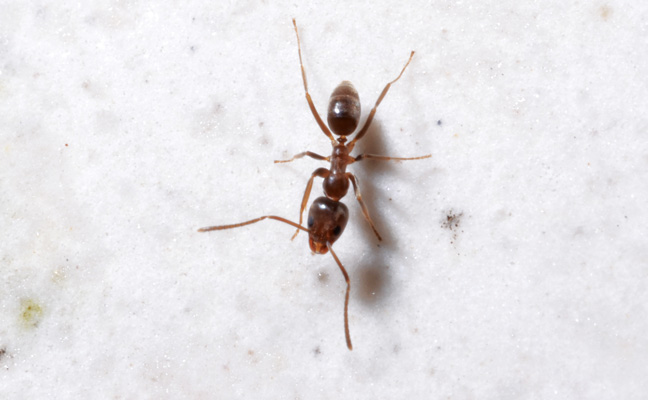
Linepithema humile
Alias: Argentine ant
Description
- This species originated in Northern Argentina near the Paraná River, and adapts well to urban and suburban environments.
- Argentine ants will persist where other species do not thrive.
- They may be the only ant species present in many locations.
- Workers are very aggressive, and often eliminate other ants in the area.
- Because different Argentine ant colonies may coexist in the same area, the number of colonies in an area may be large. As a result, locating every nest may be challenging.
- Workers are 1/12- to 1/8-inch long, and are light to dark brown. They have one segmented petiole and 12-segmented antennae with no club.
- Queens are 1/16- to 1/4-inch long.
Life Cycle
- Many fertile queens are present in each nest, where they lay eggs.
- Because mating usually takes place inside the nest, winged forms typically are not found.
- Queens clean and feed themselves, and are active in feeding and grooming immatures.
- New colonies may be formed through “budding,” whereby some fertile queens and some workers become isolated from other members of the colony and establish a new colony.
Behavior
- Nests usually are located near water and food sources, in moist soil next to or under buildings, along sidewalks and brick or stone walkways, or under boards and potted plants.
- Backyard landscape features provide an ideal habitat.
- Argentine ants use cracks and crevices to gain entry to homes in search of food or water.
- Nests may be located within a structure or other locations not typically considered soil-related, such as under a bathtub set above a slab-on-grade foundation; under the cracks or expansion joints of slabs; or under the insulation in an exterior wall void.
Food
- Argentine ants prefer sweet foods, especially sugars, syrup, fruit juices, plant secretions, and honeydew.
- Workers forage for food along paths extending out from the nest, branching out to explore every part of an area.
- Foragers may enter homes in large numbers, particularly when conditions outdoors become too wet or dry.
- Foraging range is such that nests may be located in properties adjacent to a customer’s yard and home, making control challenging.
Range
➔ The ants may be found in most regions with Mediterranean climates or with mild winters and moderate to high humidity.
➔ In the United States, they are common in coastal regions, such as California.
Prevention
➔ Maintain proper sanitation in homes and yards; seal entry points into structures; and remove landscape features (such as those that generate excess water) that provide ideal habitats.
SOURCES:
Truman’s Scientific Guide to Pest Management Operations
University of California Riverside, Center for Invasive Species Research