
No audio available for this content.
Social Wasps
Yellowjackets (Vespula spp. and Dolichovespula spp.)
- Yellowjackets are small, stout wasps about 0.5 of an inch long, with black and yellow banding
- Queens are larger, reaching 0.75 of an inch
- Ground-nesting yellowjackets (Vespula spp.) build nests below ground, often in old rodent burrows
- Aerial-nesting yellowjackets (Dolichovespula spp.) build exposed paper nests in trees, shrubs or structures such as eaves or attics
Bald-faced hornets (Dolichovespula maculata)
- Despite their name, bald-faced hornets are a type of yellowjacket
- Black with white or creamy markings on the face and end of the abdomen
- Large, robust body (up to 0.875 of an inch long)
- Build large, enclosed aerial nests (up to 2 feet wide) from chewed wood pulp
- Aggressive and capable of stinging repeatedly
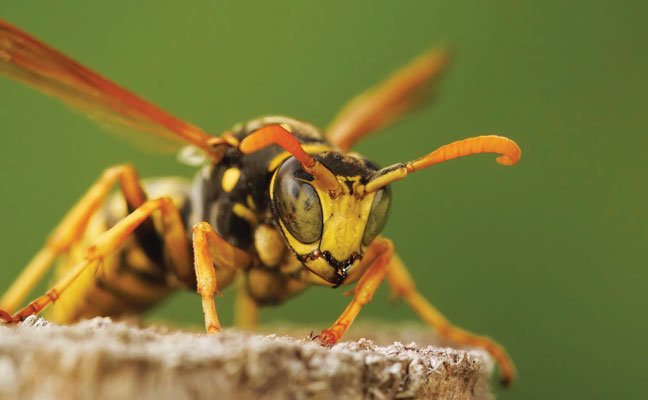
Paper wasps (Polistes spp.)
- Paper wasps are slender, with long legs and a more tapered body compared to yellowjackets
- Size: 0.75 to 1 inch
- Color: Typically reddish-brown with yellow markings
- Build open, umbrella-shaped nests with a single comb suspended by a stalk
- Less aggressive unless provoked
Solitary Wasps
Wasps / Thread-waisted wasps (Sphecidae)
- Range from 0.75 to 2 inches long
- Distinct narrow waists; bodies are often black with yellow, red or white markings
- Females excavate ground nests and provision them with paralyzed prey (such as grasshoppers or crickets)
- Adults feed on nectar
Cicada killers (Sphecius speciosus)
- Large wasps, 1.125 to 1.625 inches long
- Black and yellow markings with rusty-red thorax and brownish wings
- Prefer dry, sandy soil with sparse vegetation for nesting
- Females paralyze cicadas for larval food
- Adults feed on nectar and overwinter as larvae in soil
Sand wasps (Bembix spp.)
- Stout-bodied with pale greenish-yellow and black markings
- Females dig short burrows in sunny, sandy soil
- Prey mainly on flies for larval food
- Not aggressive; sting only if disturbed
Mud daubers (Sceliphron spp., Chalybion spp.)
- Slender body with a long, thread-like waist
- Color varies: metallic blue (blue mud dauber), black and yellow (black-and-yellow mud dauber), or solid black (organ-pipe mud dauber)
- Females construct mud nests on walls or under eaves
- Provision nests with spiders for their larvae